



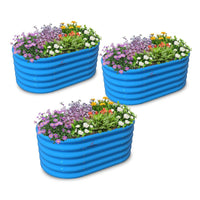
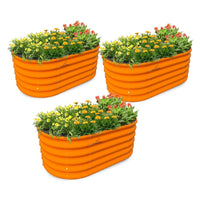
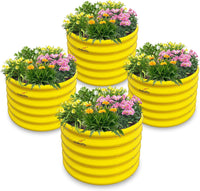
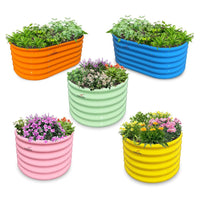



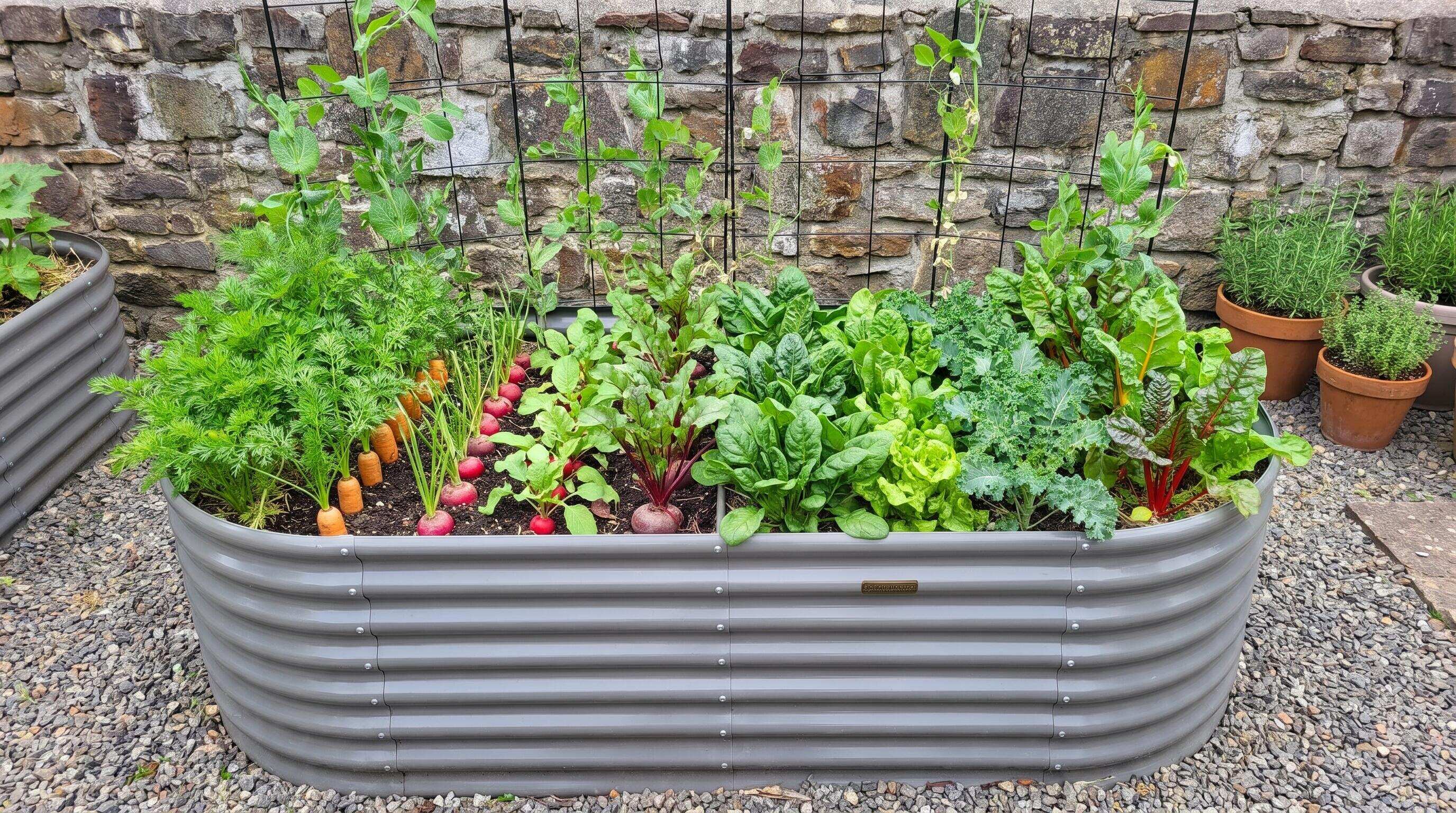
ALT: Raised bed garden layout comparison showing root vegetables and leafy greens growing in galvanized steel beds
Raised Bed Garden Layout: Why Bed Height Is the Decision That Changes Everything
Choosing the right raised bed garden layout is one of the most consequential decisions a home grower can make — and in our work with gardening enthusiasts across North America, the question we hear most often is surprisingly simple: "Does bed height actually matter?" The short answer is yes, dramatically. A raised bed planting layout that ignores depth requirements leaves root vegetables cramped and leafy greens overwatered, turning a promising season into a frustrating one.
This article compares two fundamentally different raised bed layout approaches — shallow beds designed for leafy greens versus deep beds engineered for root vegetables — across the criteria that matter most to real home gardeners: root zone depth, drainage behavior, soil volume, ergonomics, cost efficiency, and planting flexibility. By the end, you will know exactly which configuration suits your crops, your space, and your season.
What to Look For When Evaluating Raised Bed Height
The right bed height for your raised bed garden layout depends on matching the physical needs of your chosen crops to the structural capabilities of your bed. These are the six criteria that consistently predict gardening success or frustration.
Root zone depth is the most fundamental criterion. Every plant has a characteristic rooting depth — the vertical distance through which its roots must travel to anchor the plant, absorb water, and extract nutrients. Shallow-rooted crops like lettuce and spinach thrive in modest soil depths, while deep-rooted crops like carrots, parsnips, and beets require significantly more vertical space to develop full, undeformed harvests.
Drainage and moisture retention matter because bed height directly controls how well water moves through your soil system. Taller beds drain faster and prevent the waterlogging that rots root vegetables. Shallower beds retain moisture longer, which benefits leafy greens that prefer consistent, even hydration.
Soil volume and cost scale directly with height. A taller bed requires considerably more amended soil — a meaningful expense when you are filling with quality compost-rich mixes. Understanding which crops genuinely need that depth avoids unnecessary cost.
Ergonomics and accessibility become especially important for retirees, those with mobility limitations, or anyone gardening in a small urban space. Taller beds reduce bending and kneeling, making gardening physically sustainable over the long term.
Thermal performance is often overlooked. Taller beds hold more soil mass, which moderates temperature swings — a real advantage for cool-season root crops. Shallower beds warm up and cool down quickly, which can either benefit or harm leafy greens depending on your climate and season.
Planting flexibility describes how well a given bed height accommodates crop rotation, succession planting, and companion planting strategies. A versatile raised bed layout supports multiple crop types across a full growing season rather than locking you into a single planting scenario.
The Contenders: Shallow Beds for Leafy Greens vs. Deep Beds for Root Vegetables
Shallow Beds (Ideal for Leafy Greens and Herbs)
A shallow raised bed is a garden bed with a depth typically in the range of 11 to 18 inches — enough soil volume for surface-feeding crops without the material cost of a taller structure. Leafy greens are crops that produce edible foliage rather than edible roots or fruits; they include lettuce, spinach, kale, Swiss chard, arugula, basil, and most culinary herbs.
In our experience working with home gardeners, leafy greens are almost universally the entry point for raised bed gardening. They germinate quickly, harvest early, and tolerate closer plant spacing than almost any other category of vegetable. Their root systems are fibrous and relatively shallow — most extend only 6 to 12 inches into the soil — which means a standard 18-inch bed gives them ample room with considerable margin to spare.
The strategic advantage of a shallower bed for leafy greens is economic. You fill less volume with purchased soil amendments, and because leafy greens cycle quickly (many varieties go from seed to harvest in under two months), you can run multiple succession plantings through the same bed in a single season. For urban micro-gardeners and families working with limited outdoor space, a compact, well-planned shallow raised bed is often the highest-yield option per square foot.
Anleolife's galvanized steel raised garden beds available in 18-inch height configurations are well-suited to leafy green production. The 18-inch depth sits at the sweet spot — deeper than the actual root zone of most leafy crops, which means the lower few inches act as a moisture reservoir, reducing how often you need to water during hot stretches.
Deep Beds (Essential for Root Vegetables)
A deep raised bed is a garden bed with a depth of 24 inches or more, engineered to give tap-rooted and bulbing crops the unobstructed vertical soil column they require. Root vegetables are crops that store energy and water in underground organs — carrots, parsnips, beets, turnips, daikon radishes, and potatoes are the most common examples grown by home gardeners.
Root vegetables are the category where bed height most directly determines harvest quality. A carrot grown in insufficient depth hits resistance — whether that is compacted subsoil, the floor of a shallow bed, or simply the edge of available loose soil — and responds by forking, stunting, or developing misshapen roots. The difference between a 18-inch bed and a 24- to 30-inch bed is not academic for root crops; it is the difference between a straight, full-sized carrot and a twisted, stunted one.
Deeper beds also carry a thermal advantage for root crops. Because roots are the harvested organ and are sensitive to temperature extremes, the insulating mass of a deeper soil column protects developing roots from sudden heat spikes that are common in mid-summer and early fall. A pattern we consistently see is that gardeners who switch from shallow to deep beds for their root vegetable section report noticeably more uniform harvests with far fewer deformed specimens.
Anleolife offers galvanized steel raised garden beds in 24-inch extra tall and 30-inch extra tall configurations, specifically designed to meet the depth requirements of serious root vegetable production. These beds are built from galvanized steel with a projected lifespan of 20 years, making the deeper investment in both structure and soil genuinely worthwhile over the long term.
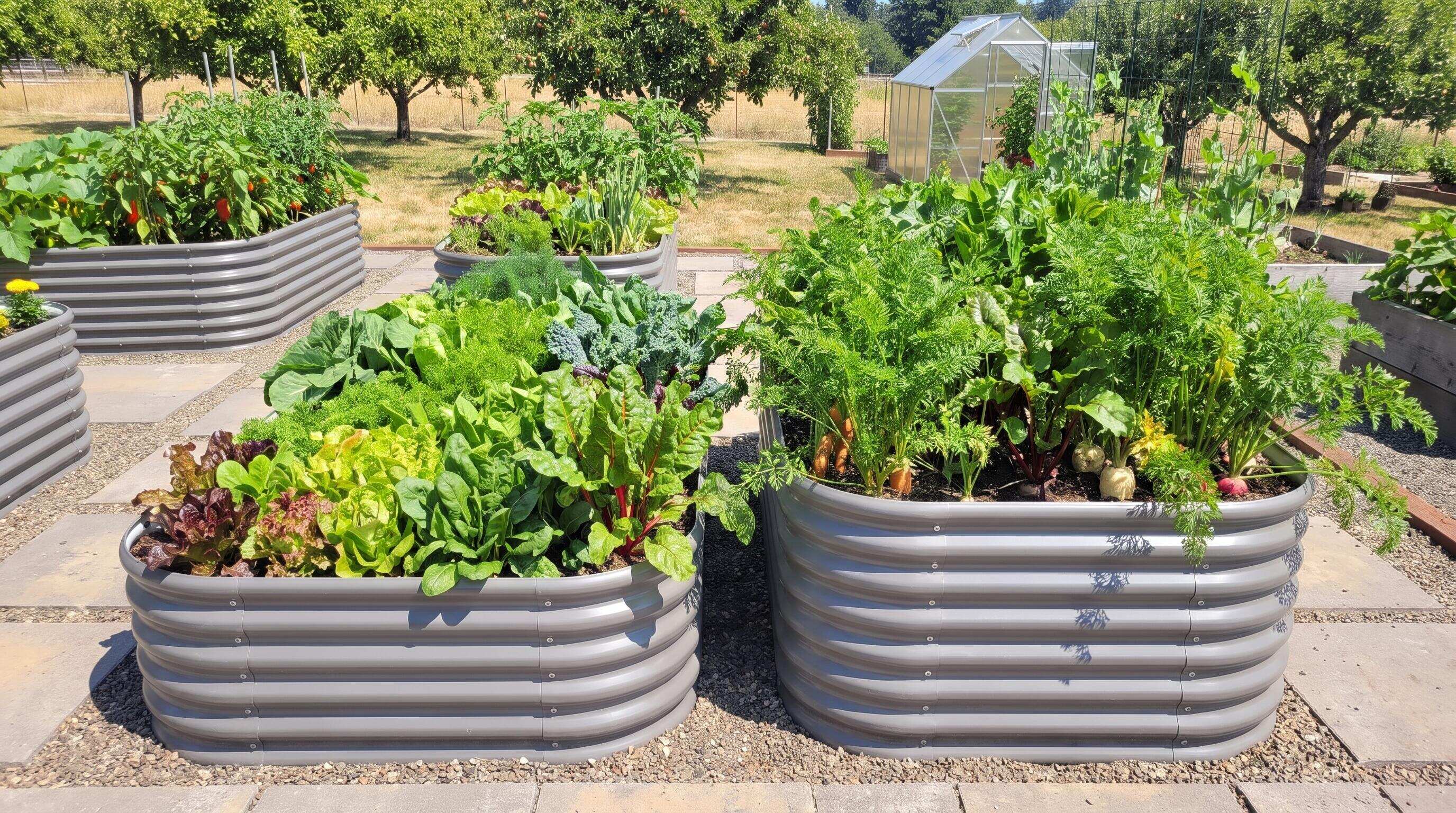
ALT: Side-by-side raised bed planting layout showing 18-inch shallow bed with leafy greens and 30-inch deep bed with root vegetables growing in galvanized steel garden beds
Head-to-Head Comparison: Shallow Beds vs. Deep Beds for Your Raised Bed Layout
| Criterion | Shallow Beds (18") — Leafy Greens | Deep Beds (24"-30") — Root Vegetables | Extra-Tall Waist-High Beds (30"-35") — Mixed Use |
|---|---|---|---|
| Root zone depth match | Excellent for leafy greens and herbs | Excellent for carrots, beets, parsnips | Suitable for most vegetable types |
| Drainage performance | Moderate — retains moisture well | Superior — fast drainage prevents rot | Superior drainage with high soil volume |
| Soil volume required | Lower | Significantly higher | Highest |
| Ergonomic accessibility | Moderate — some bending required | Good — reduced bending | Best — near waist-level, minimal bending |
| Thermal insulation for roots | Moderate | Good — large soil mass moderates temperature | Best — maximum soil mass |
| Initial cost of bed and soil fill | Lower | Higher | Highest |
| Planting flexibility | High for cool-season crops | Moderate — depth is specialized | Highest — accommodates nearly all crops |
| Season extension potential | Moderate | Good | Good |
| Best season for North America | Spring and fall primarily | Spring through fall | Year-round versatility |
The most important takeaway from this comparison is that neither bed type is universally superior — they are optimized for fundamentally different crops, and a thoughtful raised bed garden layout uses both strategically rather than treating one height as a one-size-fits-all solution.
For leafy greens, shallow 18-inch beds deliver excellent results at the lowest material cost. Because leafy crops cycle quickly and their roots are genuinely shallow, the extra soil depth of a 24- or 30-inch bed adds cost without adding meaningful crop benefit. The moisture retention characteristics of an 18-inch bed also happen to suit leafy greens well: these crops prefer consistent moisture rather than the fast-draining conditions that root vegetables need.
For root vegetables, the depth of the soil column is not optional — it is a biological requirement. Carrots, parsnips, and beets will grow in an 18-inch bed, but they will almost never reach their full potential size, and the rate of deformed roots increases significantly when the available depth is tight. A 24- or 30-inch bed is the appropriate specification for a dedicated root vegetable section of any raised bed planting layout.
The extra-tall and waist-high configurations — particularly the 30-inch and 35-inch options in Anleolife's lineup — offer a different value proposition. These beds are physically accessible without bending or kneeling, which makes them the right choice for gardeners with back problems, joint issues, or mobility limitations. They also hold enough soil depth to grow virtually any vegetable category, making them an excellent choice for mixed-planting scenarios where you want both root crops and leafy greens in the same structure.
Which Should You Choose? Scenario Recommendations for Every Gardener
If you are a beginner gardener starting your first raised bed layout this season, choose an 18-inch bed and start with leafy greens. The quick harvest cycles provide immediate gratification and genuine feedback on your soil and watering practices before you invest in deeper, more expensive structures. Leafy crops in an 18-inch bed are genuinely forgiving — a minor soil imbalance or inconsistent watering rarely causes total crop failure the way it can with long-season root vegetables.
If you have been gardening for a season or two and want to expand into root vegetables, add a 24-inch extra tall bed as a dedicated root section. Keep your existing 18-inch beds for leafy greens and herbs, and use the deeper bed specifically for carrots, beets, and radishes. This two-tier raised bed planting layout is the approach a pattern we consistently recommend and one that consistently delivers better overall harvests than trying to grow root crops in a standard-depth bed.
If you are an older gardener, someone recovering from injury, or anyone who finds bending painful, prioritize the 30-inch or 35-inch waist-high configurations. The ergonomic benefit of not having to bend or kneel is significant for long-term sustainable gardening, and the depth of these beds means you can grow any crop category without compromise. The 35-inch waist-high 4x1.5 ft option from Anleolife is particularly well-suited to compact spaces where accessibility is the priority.
If you are designing a full kitchen garden for a family, the most effective raised bed layout combines multiple heights: 18-inch beds positioned in areas with slightly more shade for lettuce, spinach, and herbs (which benefit from some afternoon shade in summer), and 24- to 30-inch beds in the sunniest positions for root vegetables and larger fruiting crops. This zoned layout maximizes every square foot of your growing space.
If space is limited and you can only choose one bed height, go with 24 inches. It is deep enough for most root vegetables, comfortable for leafy greens, and represents the best single-height compromise for a genuinely versatile raised bed garden layout.
Pros and cons summary:
Shallow 18-inch beds offer lower cost, faster soil warm-up, excellent moisture retention for leafy crops, and lighter overall weight for repositioning. Their limitation is that they constrain root vegetable potential and provide less ergonomic relief.
Deep 24- to 30-inch beds provide full root development for all vegetable categories, superior drainage, and meaningful ergonomic benefit. Their limitation is higher initial cost — both for the bed structure and the soil volume required to fill them.
Common Questions
Q1: How deep does a raised bed need to be for carrots specifically?
Carrots are among the most depth-sensitive vegetables in home raised bed gardening. Most standard carrot varieties require a minimum of 12 inches of loose, unobstructed soil, but longer varieties such as Imperator types can reach 10 to 12 inches in root length and benefit from 18 to 24 inches of soil depth to develop without restriction. For a dedicated carrot section of your raised bed planting layout, a 24-inch extra tall bed is the most reliable choice — it eliminates the deformed root problem entirely and allows you to grow any carrot variety without selecting for short types.
Q2: Are shallow beds suitable for root vegetables if I use the right soil mix?
Shallow beds can support some root vegetable varieties — specifically short-rooted cultivars like Chantenay or Paris Market carrots, or round beet varieties — but they will always limit the full potential of longer-rooted types regardless of soil quality. Even a perfectly amended, loose, stone-free soil mix cannot compensate for a physical depth restriction when a root simply runs out of space. For most home gardeners who want a full harvest of standard root vegetable varieties, a shallow raised bed is a compromise that shows up at harvest time. If you are committed to a shallow bed, select your varieties specifically for their short root length.
Q3: How much does the extra soil cost to fill a deep raised bed, and is it worth it?
The soil investment for a 24- or 30-inch bed is meaningfully higher than for an 18-inch bed — the volume difference is substantial, and quality amended soil mix is not inexpensive. The honest answer is that this cost is worth it specifically for root vegetables and not necessary for leafy greens. Because Anleolife's galvanized steel beds carry a 20-year lifespan, that initial soil investment is spread across two decades of growing seasons, making the per-year cost modest. Many gardeners also reduce the fill cost by using a technique called "hugelkultur-style layering" — placing partially decomposed wood, straw, or compost at the base of deep beds — before adding their quality growing mix to the top 12 to 18 inches where roots actually develop.
Final Thoughts
The core insight of this comparison is straightforward: raised bed height is a crop-specific tool, not a one-size-fits-all specification. Leafy greens thrive in 18-inch beds, root vegetables need 24 to 30 inches of depth, and waist-high configurations serve gardeners who need ergonomic accessibility above all else.
Three principles to carry forward from this guide:
First, match depth to crop biology, not convenience. A well-planned raised bed garden layout segments crops by their root depth requirements — this single change produces more uniform, full-sized harvests than almost any other gardening adjustment.
Second, invest in bed longevity. A galvanized steel raised bed from Anleolife is engineered for a 20-year lifespan, which means the right bed chosen today supports your garden through decades of seasons. The upfront cost of a deeper bed amortizes gracefully over that timeline.
Third, design for flexibility and expansion. The most satisfying gardens we see are ones that began with a single bed and gradually expanded — adding a deep root-vegetable section one season, a waist-high accessible bed the next. Modular thinking, rather than trying to solve everything with one bed height, produces the most productive and enjoyable raised bed planting layouts over time.
Your next step is simple: identify which crop category you most want to grow this season, match it to the appropriate bed depth from this guide, and build from there. A well-designed raised bed layout is not a one-time decision — it is a garden that grows with you.
Ready to build your ideal raised bed garden layout? Explore the full range of galvanized steel raised beds — from 18-inch standard heights to 35-inch waist-high configurations — and find the depth that matches your crops, your space, and your season at the Anleolife website. With a nationwide warehouse network spanning California, Texas, Florida, New York, Illinois, and Washington, your order arrives in as fast as 3–8 business days. Whether you are starting your first bed or expanding an established kitchen garden, Anleolife's modular product design grows alongside you — from a single planting bed to a fully integrated planting-and-raising ecosystem.
Sources & Citations
- What's the Best Raised Bed Layout for Your Space? "What's the Best Raised Bed Layout for Your Space?"
https://www.gardenary.com/blog/whats-the-best-raised-bed-layout-for-your-space - How to Create a Raised Bed Garden Plan. "How to Create a Raised Bed Garden Plan"
https://scottsmiraclegro.com/en-us/learn/gardening/what-to-plant-in-a-raised-bed.html - 160 Best Raised Garden Beds ideas. "160 Best Raised Garden Beds ideas"
https://www.pinterest.com/gardenbunch/raised-garden-beds/
Note: Standards may be updated; please check the latest official documents or consult professional advisors.
- www.anleolife.com.
the Anleolife website